- 简体中文
- English

Why Demo-Stage Game Art Tests Often Fail to Give Clear Results
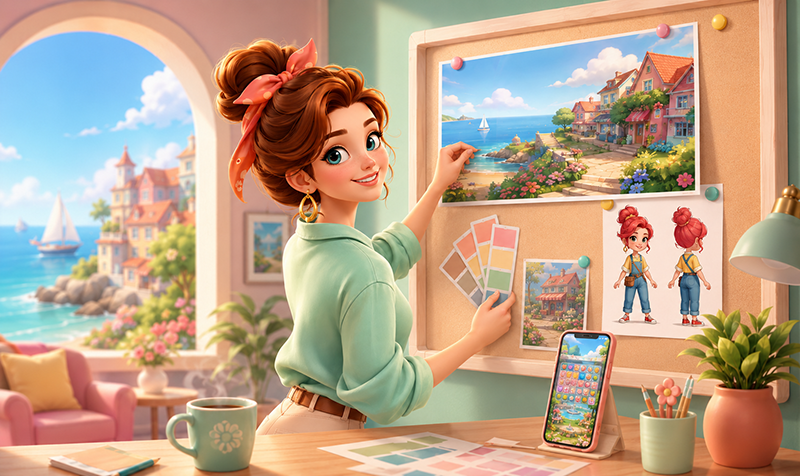
Many game projects work with external art teams during the demo stage.
However, some art tests do not get stuck because the artwork cannot be completed, or because the quality of a single image is too low. The real issue is often that the project team cannot clearly judge: is this the right visual direction?
One day, the feedback is that the style is not cartoonish enough. The next day, it needs to feel more premium. The Art Director may think the direction is acceptable, while the publishing or UA team worries that it may not perform well in ads. The external artist revises several rounds, the image improves, but the team still feels that something is missing.
This situation is very common in game art outsourcing and production collaboration.
Many demo-stage art tests fail to provide a clear conclusion not because one side lacks ability, but because one important question was not clarified before the test started:
Is this test evaluating execution ability, or is it exploring the visual direction?
Both may be called “art tests,” but they require very different evaluation standards.
1. When the Style Is Defined, the Test Should Focus on Execution
If the visual style of the project is already relatively clear, the external test should usually focus on execution ability.
Here, “clear style” does not simply mean having a few reference images. It means the internal team already has a relatively stable visual direction, and the core direction is unlikely to change frequently later.
In this case, an art test mainly looks at several points:
• Whether the external team understands the project style
• Whether they can understand and apply feedback accurately
• Whether they can deliver on time
• Whether they can support later production
• Whether they can maintain consistency across multiple batches of assets
But in real collaboration, one issue is often overlooked:
Having reference images does not always mean the style has truly been defined.
A few reference images can show the general taste or direction, but they cannot fully replace production standards.
What really affects the test result is whether there are clear execution standards behind the references, such as:
• Character and environment proportions
• Color and value range
• Material treatment
• Level of polish
• Readability at small size
• Production scalability
When these standards are clear, the external team can align faster, and the project team can evaluate the test result more objectively.
When the standards are unclear, even a well-painted image may still feel “not quite right,” while the team struggles to explain exactly what needs to change.
This is where many art tests get stuck.
2. When the Style Is Not Defined, the Test Becomes Visual Exploration
If the final visual direction has not yet been defined, the test should not simply focus on which image looks best.
At this stage, the test is closer to visual direction exploration.
During the demo stage, many teams are still deciding:
• Should the characters be 3-heads tall or 5-heads tall?
• Should the style be more stylized or more realistic?
• Should production use AI-assisted workflows, 3D-to-2D rendering, or traditional 2D?
• Should the final look be lightweight and efficient, or more detailed and highly polished?
In this situation, the purpose of the art test should not be only to produce one finished image. It should help the project team judge:
Which direction is more suitable for the game to continue testing, producing, and scaling?
There is nothing wrong with involving an external art team before the style is fully locked.
However, in this case, the external team is not only providing execution capacity. Under the client’s direction, they may also participate in visual judgment, style comparison, and production feasibility assessment.
For demo-stage projects, the value of this kind of art test is not just one finished image. It helps the project team turn abstract visual preferences into something more concrete, comparable, and executable.
3. Different Types of Tests Need Different Evaluation Standards
When the style is already defined, the test is better evaluated by pre-agreed execution standards.
For example, whether the work follows the reference style, whether feedback is understood, whether delivery is on time, and whether the team can support stable production later.
When the style is not yet defined, the test should be evaluated by direction, production feasibility, and long-term production value.
The reason is simple:
• The first type tests execution results
• The second type helps establish direction and standards
Visual exploration does not always have an absolute right or wrong answer.
Even if one direction is not adopted in the end, it may still help the project reduce risk, narrow the range of choices, and understand which directions are not worth further investment.
4. If the Team Plans to Run UA Tests, Variables Should Be Controlled
If the project plans to run marketability or UA tests later, the early art test should control variables as much as possible.
A more effective approach is to keep the following elements consistent:
• Same theme
• Same character concept
• Same story hook
• Same gameplay moment
• Different art styles only
Otherwise, if the theme, character, composition, copy, pacing, and visual style all change at the same time, the team may receive data but still be unable to identify what actually caused the result.
This is especially important for casual games, merge games, match-3 games, simulation games, and other content-driven projects that rely on ads and continuous content iteration.
The visual direction affects not only the in-game experience, but also ad performance, first impressions, and long-term production efficiency.
5. Conclusion
When a demo-stage art test does not lead to a clear conclusion, it does not always mean the external team lacks ability. It also does not always mean the client’s expectations are too high.
More often, the issue is that both sides did not clarify whether the test was about execution or visual exploration at the beginning.
If the style standards are already clear, the test should focus on execution ability:
• Whether the team understands the style
• Whether they can deliver according to the standard
• Whether they can support stable production later
If the style has not yet been defined, the test should focus on direction judgment:
• Which direction is more suitable for further validation
• Which direction has better scalability
• Which direction has stronger production feasibility and long-term value
Before starting an external art test, one simple question can save a lot of communication cost:
Are we testing whether a team can execute a known style, or are we trying to find the style itself?
The most valuable art tests are not always the ones that produce the most beautiful single image. They are the ones that help the project team make a clearer decision.
About UOWLS
UOWLS is a game art outsourcing studio supporting casual and mobile game teams with character art, environment art, props, illustrations, UI, icons, Spine animation, promotional video visuals, 3D characters, and 3D environments.
We support teams across different production stages, from early visual exploration and small-scale art tests to full production and ongoing content updates after launch.
Our experience covers Merge games, Match-3 games, simulation games, dress-up games, cooking games, Bingo games, casual SLG projects, life simulation games, and other stylized casual mobile games.
UOWLS has supported multiple mature live game projects, gaining practical experience in style consistency, scalable production, and long-term art content updates for casual and mobile game teams.
Why Demo-Stage Game Art Tests Often Fail to Give Clear Results
Many game projects work with external art teams during the demo stage.
However, some art tests do not get stuck because the artwork cannot be completed, or because the quality of a single image is too low. The real issue is often that the project team cannot clearly judge: is this the right visual direction?
One day, the feedback is that the style is not cartoonish enough. The next day, it needs to feel more premium. The Art Director may think the direction is acceptable, while the publishing or UA team worries that it may not perform well in ads. The external artist revises several rounds, the image improves, but the team still feels that something is missing.
This situation is very common in game art outsourcing and production collaboration.
Many demo-stage art tests fail to provide a clear conclusion not because one side lacks ability, but because one important question was not clarified before the test started:
Is this test evaluating execution ability, or is it exploring the visual direction?
Both may be called “art tests,” but they require very different evaluation standards.
1. When the Style Is Defined, the Test Should Focus on Execution
If the visual style of the project is already relatively clear, the external test should usually focus on execution ability.
Here, “clear style” does not simply mean having a few reference images. It means the internal team already has a relatively stable visual direction, and the core direction is unlikely to change frequently later.
In this case, an art test mainly looks at several points:
• Whether the external team understands the project style
• Whether they can understand and apply feedback accurately
• Whether they can deliver on time
• Whether they can support later production
• Whether they can maintain consistency across multiple batches of assets
But in real collaboration, one issue is often overlooked:
Having reference images does not always mean the style has truly been defined.
A few reference images can show the general taste or direction, but they cannot fully replace production standards.
What really affects the test result is whether there are clear execution standards behind the references, such as:
• Character and environment proportions
• Color and value range
• Material treatment
• Level of polish
• Readability at small size
• Production scalability
When these standards are clear, the external team can align faster, and the project team can evaluate the test result more objectively.
When the standards are unclear, even a well-painted image may still feel “not quite right,” while the team struggles to explain exactly what needs to change.
This is where many art tests get stuck.
2. When the Style Is Not Defined, the Test Becomes Visual Exploration
If the final visual direction has not yet been defined, the test should not simply focus on which image looks best.
At this stage, the test is closer to visual direction exploration.
During the demo stage, many teams are still deciding:
• Should the characters be 3-heads tall or 5-heads tall?
• Should the style be more stylized or more realistic?
• Should production use AI-assisted workflows, 3D-to-2D rendering, or traditional 2D?
• Should the final look be lightweight and efficient, or more detailed and highly polished?
In this situation, the purpose of the art test should not be only to produce one finished image. It should help the project team judge:
Which direction is more suitable for the game to continue testing, producing, and scaling?
There is nothing wrong with involving an external art team before the style is fully locked.
However, in this case, the external team is not only providing execution capacity. Under the client’s direction, they may also participate in visual judgment, style comparison, and production feasibility assessment.
For demo-stage projects, the value of this kind of art test is not just one finished image. It helps the project team turn abstract visual preferences into something more concrete, comparable, and executable.
3. Different Types of Tests Need Different Evaluation Standards
When the style is already defined, the test is better evaluated by pre-agreed execution standards.
For example, whether the work follows the reference style, whether feedback is understood, whether delivery is on time, and whether the team can support stable production later.
When the style is not yet defined, the test should be evaluated by direction, production feasibility, and long-term production value.
The reason is simple:
• The first type tests execution results
• The second type helps establish direction and standards
Visual exploration does not always have an absolute right or wrong answer.
Even if one direction is not adopted in the end, it may still help the project reduce risk, narrow the range of choices, and understand which directions are not worth further investment.
4. If the Team Plans to Run UA Tests, Variables Should Be Controlled
If the project plans to run marketability or UA tests later, the early art test should control variables as much as possible.
A more effective approach is to keep the following elements consistent:
• Same theme
• Same character concept
• Same story hook
• Same gameplay moment
• Different art styles only
Otherwise, if the theme, character, composition, copy, pacing, and visual style all change at the same time, the team may receive data but still be unable to identify what actually caused the result.
This is especially important for casual games, merge games, match-3 games, simulation games, and other content-driven projects that rely on ads and continuous content iteration.
The visual direction affects not only the in-game experience, but also ad performance, first impressions, and long-term production efficiency.
5. Conclusion
When a demo-stage art test does not lead to a clear conclusion, it does not always mean the external team lacks ability. It also does not always mean the client’s expectations are too high.
More often, the issue is that both sides did not clarify whether the test was about execution or visual exploration at the beginning.
If the style standards are already clear, the test should focus on execution ability:
• Whether the team understands the style
• Whether they can deliver according to the standard
• Whether they can support stable production later
If the style has not yet been defined, the test should focus on direction judgment:
• Which direction is more suitable for further validation
• Which direction has better scalability
• Which direction has stronger production feasibility and long-term value
Before starting an external art test, one simple question can save a lot of communication cost:
Are we testing whether a team can execute a known style, or are we trying to find the style itself?
The most valuable art tests are not always the ones that produce the most beautiful single image. They are the ones that help the project team make a clearer decision.
About UOWLS
UOWLS is a game art outsourcing studio supporting casual and mobile game teams with character art, environment art, props, illustrations, UI, icons, Spine animation, promotional video visuals, 3D characters, and 3D environments.
We support teams across different production stages, from early visual exploration and small-scale art tests to full production and ongoing content updates after launch.
Our experience covers Merge games, Match-3 games, simulation games, dress-up games, cooking games, Bingo games, casual SLG projects, life simulation games, and other stylized casual mobile games.
UOWLS has supported multiple mature live game projects, gaining practical experience in style consistency, scalable production, and long-term art content updates for casual and mobile game teams.